Po Nagar’s goddess: reading the lintel, the stelae and the Hindu-Cham layers
Who is carved over Po Nagar’s door? Sources disagree. Follow the goddess through Hindu iconography, royal inscriptions and living Thiên Y A Na worship in Nha Trang.
 Cat Ba Connect4 min read
The short answer
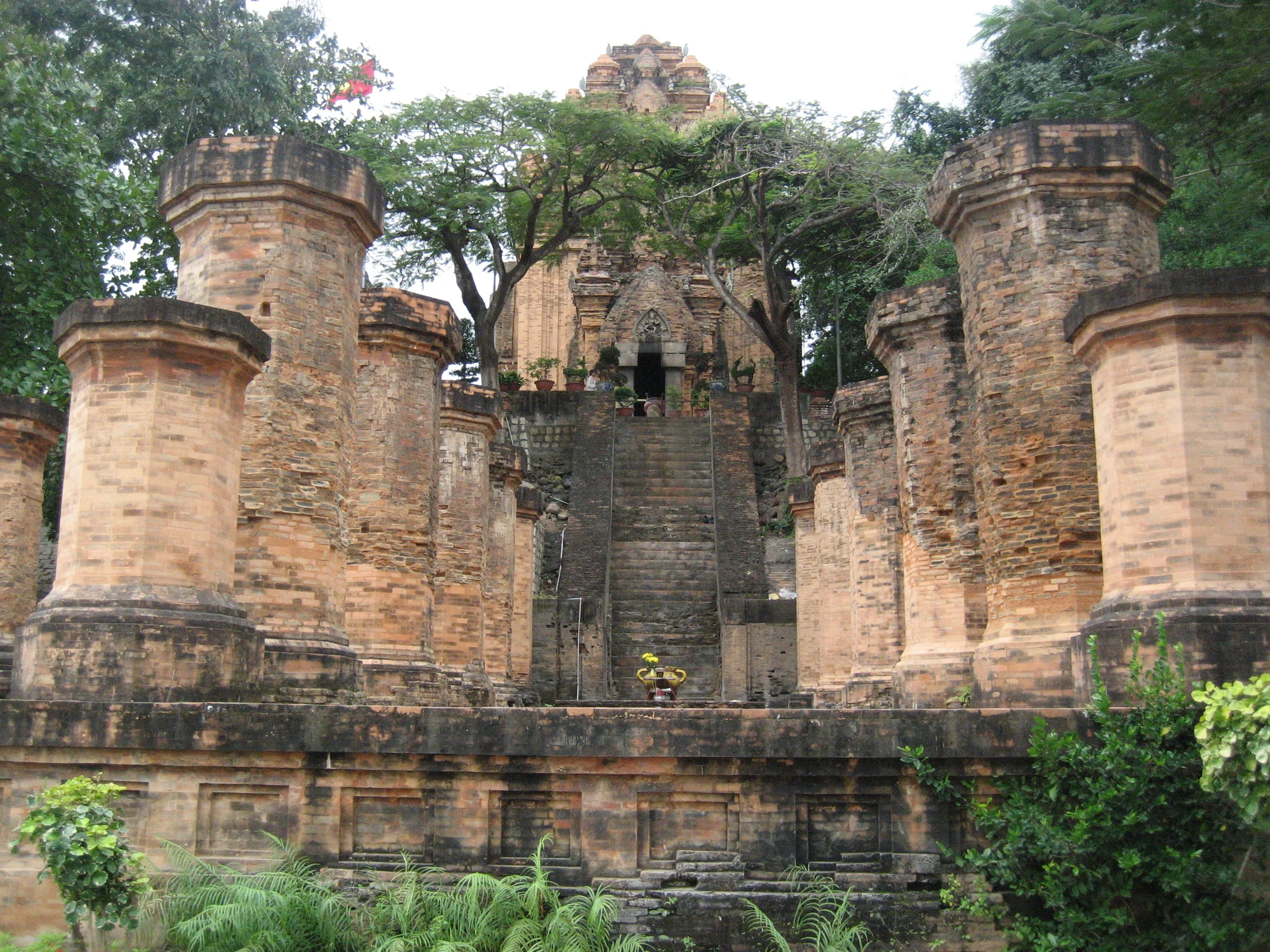
Po Nagar’s goddess has several names because several communities have honoured her. Inscriptions and art historians connect Yan Po Nagar with Bhagavatī, a form of Umā, and her statue’s attributes with Durga as buffalo-slayer. Vietnamese worshippers know her as Thiên Y A Na, a mother goddess. Even the carving above the main door is described differently by different sources. The best way to read the site is to hold those layers side by side instead of choosing one and calling it the truth.
The carving over the door is an open question
Start with a small argument you can settle by looking. Khanh Hoa’s tourism page describes the relief above the main tower’s threshold as Shiva dancing with one foot on the bull Nandin, between two musicians, and dates it to the 11th century. The Arts in Southeast Asia database of Thailand’s Sirindhorn Anthropology Centre calls the tympanum Mahiṣāsuramardinī, the goddess who destroys the buffalo demon. Other accounts, drawing on published scholarship, also describe a four-armed Mahiṣāsuramardinī standing on a buffalo.
So stand below it and ask three questions. Does the animal read as a bull or a buffalo? Does the figure read as male or female? How many arms, and what do the hands hold? You will not resolve the dispute, but you will see exactly what it turns on: one animal and one body, read through different expectations.
Stone records of a statue that kept being replaced
Published summaries of the inscriptions read like an insurance file. A stele of 781 says King Satyavarman restored a temple plundered by foreign raiders who broke the linga and took its treasure. In 784 the linga was restored. A stele of 918 records a golden image of Bhagavatī ordered by Indravarman III. The Khmer king Rajendravarman II is said to have taken that gold statue in 950, and in 965 Jaya Indravarman I replaced it in stone.
Read this way, the goddess’s stone body is the answer to a theft. The inscriptions you can see most readily are on the two stone pillars of the east door, in Old Cham and Sanskrit, according to the provincial page. Few visitors can read them, but kings used this doorway to put obligations on record.
Why one goddess holds so many names
The Sirindhorn database reads the site as Devī, personifying the power of the gods, and suggests a regional balance in Champa: Shiva linked with the mountains at Mỹ Sơn in the north, the goddess linked with the ocean at Po Nagar in the south. Treat that as a scholarly reading, not doctrine.
The seated statue adds its own evidence. It is carved from a single block of granite and set on a yoni base, which merges a goddess image with the linga-yoni form. The scholar Ngô Văn Doanh links its attributes to Mahiṣāsuramardinī. Published accounts describe a ten-armed figure about 1.2 metres tall, so count the hands if the interior is open and any robes allow it.
Thiên Y A Na: the layer that is still in use
Kinh Vietnamese worship did not erase what came before; it reassigned it. The provincial page maps Hindu dedications onto a Vietnamese family: the Shiva tower is linked with Nam Hải, husband of Thiên Y A Na, while other towers became Tháp Cố and Tháp Cô Cậu. Shrines to her two children flank her altar. She is honoured as a mother of the land who brings fertility and protection, and legend credits her with teaching rice farming and weaving.
This is why offerings here are not a historical re-enactment. The Tháp Bà festival falls in the third lunar month, and sources give slightly different dates, so confirm them for your year. Pilgrims traditionally climbed stooping and left without turning their backs on the temple. Give them that space, and ask before photographing anyone.
Whose goddess is she today?
The easiest mistake is to narrate Po Nagar as a Cham past followed by a Vietnamese present. Cham communities remain part of Vietnam, and the Da Nang Museum of Cham Sculpture keeps a gallery on the festivals and crafts of Cham people in Ninh Thuận. Ask local guides how Cham visitors relate to the temple now, and notice whether labels on site mention them at all.
The state listed Po Nagar as a national historical site in 1979, according to one Vietnamese report, and the festival has been recognised as national intangible heritage. Those listings protect a place with more than one set of owners in memory. If you can only read one thing closely, make it the door: goddess, king, pilgrim and tourist all pass through it.
Questions travellers ask
Is the Po Nagar goddess Uma, Durga or Thiên Y A Na?
Sources connect her with all three in different ways. Bhagavatī is treated as a form of Umā, the statue’s attributes are linked to Durga as Mahiṣāsuramardinī, and Thiên Y A Na is her Vietnamese identity.
Does the carving above the door show Shiva or a goddess?
Sources differ. Khanh Hoa’s tourism page describes a dancing Shiva on Nandin, while the Sirindhorn database and other accounts describe Mahiṣāsuramardinī. Look closely, then ask the site’s staff or your guide which reading they follow.