Khai Dinh’s tomb up close: the broken-ceramic mosaic and its concrete frame
Inside Khai Dinh’s tomb in Hue: how imported cement, broken ceramic and coloured glass became Thien Dinh Palace’s walls, and what to look for in the dim rooms.
 Cat Ba Connect4 min read
The short answer
Khai Dinh’s tomb is best read as a concrete building wearing a ceramic skin. Begun in 1920 and finished in 1931, it used cement, iron and slate from France, with porcelain and coloured glass reported from China and Japan. Inside Thien Dinh Palace, those fragments become reliefs of seasons, blessings and treasures. Allow more time for the interior than for the famous stairway, let your eyes adjust to the low light, and look at how individual shards have been cut and fitted.
Start with the material list, not the skyline
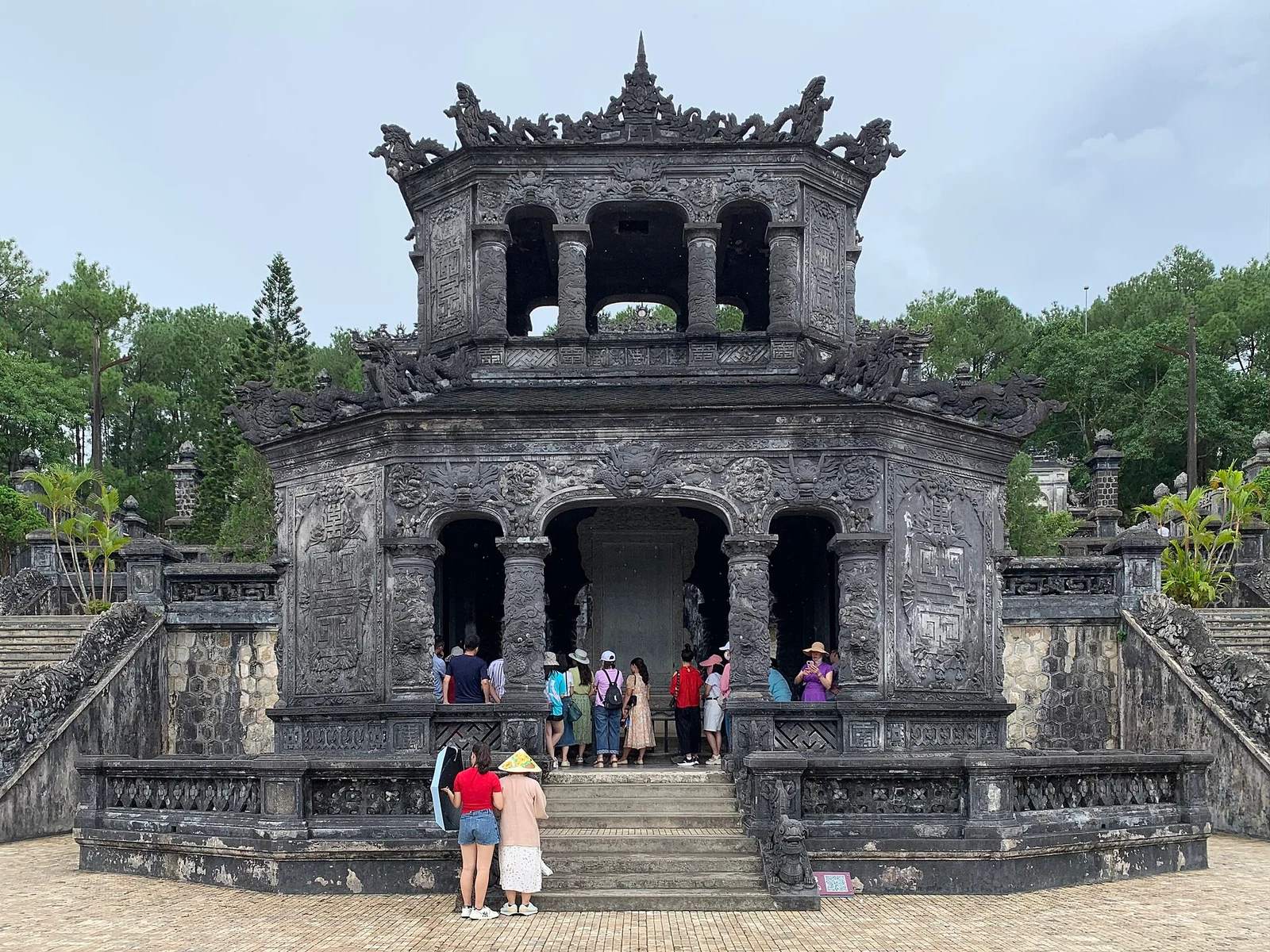
Most first impressions of this tomb are about its dark, gothic-looking hillside mass. A better opening is the shopping list. Huế’s tourism portal says iron, steel, cement and Ardoise slate were bought from France, while porcelain, glassware and coloured crystal came from China and Japan. Earlier Nguyễn tombs in the same hills lean on timber, brick and landscape. This one sets its builders a different problem: how do you make cement look imperial?
The site itself is compact, about 117 by 48.5 metres, yet the portal calls it the smallest Nguyễn tomb with the longest construction time. Work began on 4 September 1920 and ended in 1931, after Khải Định’s death in 1925, under Bảo Đại.
Why a shard is more interesting than a whole plate
The Vietnamese term you will hear is khảm sành sứ, the inlaying of broken ceramic and glass. Published descriptions speak of tens of thousands of pieces fitted together. What deserves your attention is what the shard can do that paint cannot: a curved fragment already has a glaze, a colour and a shape, and the craftsman chooses among found curves as a painter chooses a stroke.
Up close, try to identify single sources. Can you see a rim, a foot ring or a fragment of decoration that was made for another purpose? Where a petal or a cloud bends, does the artisan cut the piece to fit or choose a piece that already bends? Those are questions no photograph answers well, and they are the reason to come inside.
Three chambers, read left to right, then upward
Viet Nam News identifies the three central chambers of Thiên Định Palace as the artistic core, with relief mosaics of ceramic and coloured glass on walls and columns. Look for the named subjects in published accounts: the Four Seasons, the Five Blessings and the Eight Precious Objects, plus still lifes of fruit and tea sets. Note how ordinary some are: a tea set rendered in broken porcelain.
Then look up. The ceiling painting of nine dragons among clouds is credited to the court artist Phan Văn Tánh, and guides often add that he painted it partly with his feet. That story appears in travel writing without firm evidence, so treat it as a story. Bring patience: this part of the building is dim, and phones struggle.
The canopy that pretends to be silk
Above the seated bronze figure of the king hangs a canopy said to weigh about one tonne, modelled so its folds seem like soft cloth. It is the room’s best trick, and sources do not even agree on what it is. One Vietnamese visitor guide calls it bronze in one paragraph and reinforced concrete in another. The statue’s story is equally slippery: Marseille, France in 1920, or France in 1922, depending on the account.
Take that as a sign of how thin the popular record is. If a guide gives you an adhesive recipe or a master mosaicist’s name, ask where it comes from. One resort feature traces the technique to the Lý dynasty and offers a mortar recipe, but cites no evidence.
Taste, money and how to judge the result
Khải Định’s tomb is admired and disliked, sometimes in one sentence, and the mix of Hindu, Buddhist, Gothic and Roman references can feel like a catalogue. Huế’s portal also notes that the work cost people labour and property, a point worth keeping alongside the glitter.
Your own judgement will be sharper if you compare it with an older tomb on the same day. Note how Minh Mạng’s landscape asks you to walk, and Khải Định’s interior asks you to stand still. Keep to the marked route, do not touch the walls, and remember that a loose shard here cannot be replaced from a shop. Ask about opening times and any restoration work when you buy your ticket.
Questions travellers ask
Is the mosaic made from smashed Chinese and Japanese bowls?
Sources say porcelain and coloured glass were brought from China and Japan and fragments were fitted into reliefs. The exact origin of any piece you see cannot be confirmed by eye.
How long should I allow inside Thien Dinh Palace?
Plan for unhurried time rather than a fixed figure. The interior is the reason to come, and it needs longer than a walk-through because the light is low.