Independence Palace as architecture: Ngo Viet Thu’s modernist screen and symbolism
Beyond the tanks: read Independence Palace as 1960s Vietnamese modernism. How Ngo Viet Thu’s stone screen works, and how far to trust stories of hidden characters.
 Cat Ba Connect4 min read
The short answer
Independence Palace is worth reading as a building, apart from 1975. Ngô Viết Thụ, winner of the Grand Prix de Rome, designed it for a government that had just had its old palace bombed, and it opened in 1966. Its stone screen shades the upper floor while recalling bamboo and Huế, and its facade is often said to spell out auspicious Chinese characters. Look first at how the screen handles light and air. Treat stories about hidden meanings as interpretation, and note who is telling them.
A building made in a hurry, by someone trained in Rome
Begin with the circumstances. Two dissident pilots badly damaged the old Norodom Palace in 1962, and President Ngô Đình Diệm ordered a replacement. Construction started on 1 July 1962 and the new palace was inaugurated on 31 October 1966. Some travel pages date Ngô Viết Thụ’s appointment to 1967, which cannot be right.
Thụ had won the First Grand Prize of Rome in 1955, spent the following years at the Villa Medici, and returned to Vietnam in 1960 at Diệm’s invitation. He was thus a Beaux-Arts man working out a modern Vietnamese language in several projects at once, including the Huế University campus and the Đà Lạt atomic centre. The palace is his most public statement, built when the state badly needed one.
The screen is the building’s real facade
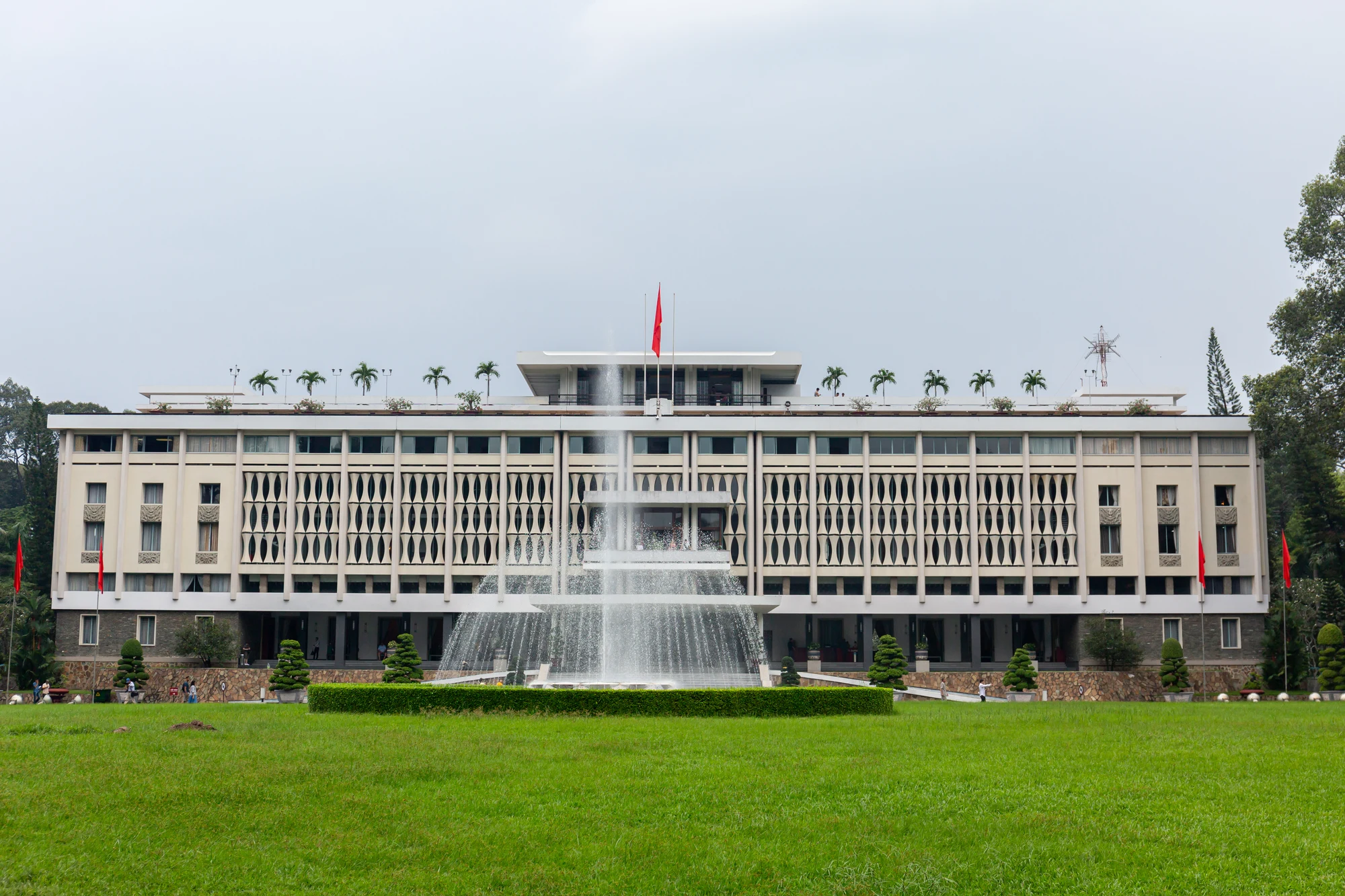
Stand on the lawn and look at the second floor. The stone screen reads as a row of bamboo segments, and Vietnam Discovery calls it a flower curtain inspired by the gates of Huế’s Imperial Palace. Some accounts credit the idea to the sculptor Nguyễn Văn Thế, so check that on site. The effect is clear either way: a heavy institution appears to have a light, breathable skin.
Its function matters as much as its poetry. Znews says it screens the corridor from the avenue while letting in air and light. Walk behind it if the route allows, and watch how the shadow falls on the gallery. This is climate modernism: deep shade, moving air and a surface that changes with the hour.
Hidden characters: enjoy them, then question them
The best-known story says that the plan and elevation spell auspicious Chinese characters: Cát for good fortune in the overall mass, with Tam, Vương, Chủ, Khẩu, Trung and Hưng in the facade and its parts, carrying ideas about leadership, sovereignty and prosperity. Popular explanations are precise, but most trace to commentary, not to drawings you can check. This guide could not open the palace’s own architecture page, so read the wall texts on site.
Znews offers a useful counterweight. Its writer asks whether Trung means loyalty or merely centre, notes that the Cát shape narrows towards the back, something geomancers usually avoid, and dismisses claims that bamboo joints foretold the fate of Diệm’s family. Son Ngô Viết Nam Sơn reportedly said that his father kept a direct axis into the building, a feature some think unlucky, and used the lake to counter it. So there is intent here, but also legend.
Read the plan as modernism in a Vietnamese accent
The building is usually called Vietnamese modernist, and Wikipedia gives four floors and a height of 26 metres, though floor-area figures differ widely between sources. Vietnam Discovery gives 95 rooms and notes a semicircular lake with lotus and water lilies that recalls the ponds of temples and pagodas. That is the method in small: a modern frame, then a familiar element placed so that a Vietnamese visitor recognises it.
Look at the thresholds. Long horizontal lines and a generous lawn give the entrance a formal calm, and the lake holds visitors at a distance from the door. Is that hospitality or defence? Both answers are plausible for a palace built after an air attack.
Visiting with an architect’s eye
Our main guide to the palace deals with its political history, routes and tickets, and you should read its advice on checking the visitor route. For an architectural visit, come when the sun is low enough for the screen to cast shadows, and spend the first fifteen minutes outside. The rooms give you furniture and history, but the lawn gives you the building.
Inside, follow the marked route, and watch how corridors connect rooms. This was also a seat of power in a war, and it remains a site of memory for families on different sides. A beautiful screen does not cancel that.
Questions travellers ask
Who designed Independence Palace?
Ngô Viết Thụ, a Vietnamese architect who won the First Grand Prize of Rome in 1955. Construction began in 1962, and the building was inaugurated in 1966, replacing the bombed Norodom Palace.
Does the building really spell Chinese characters?
That is a popular interpretation, repeated in many accounts, but it is debated in its details. Treat it as a reading of the building, and check the palace’s own interpretation on site.