Hue’s citadel walls: where Vauban meets feng shui along the Perfume River
Hue’s outer walls answer two questions at once: how to stop cannon, and how to sit well in a landscape. A guide to the ramparts, gates, islets and Ngu Binh hill.
 Cat Ba Connect4 min read
The short answer
Hue’s outer citadel combines two logics. Its low, thick ramparts with regularly spaced bastions follow European Vauban-style fortification, while its site and orientation follow geomancy: Ngự Bình hill as a front screen, the Perfume River as the bright hall, and two islets as dragon and tiger. Most visitors go straight to the Imperial City inside. Walk at least one section of the outer circuit instead, starting at a southern gate, and you will see the capital’s real plan.
Leave the palace and start at the outside edge
The Imperial City holds the crowds, but the capital’s argument lies in the outer wall. A joint exhibition by Huế’s conservation centre and the National Archives described the Kinh Thành as near square, about 520 hectares, with a perimeter of more than 10,500 metres, three rings of wall and a shared axis facing south-southeast. Published descriptions of the outer rampart give 6.6 metres of height and 21 metres of thickness, although a shorter figure of 2 metres also circulates, so ask a guide about any number that matters to you.
Think of it as a city-sized machine. It took nearly 30 years. Work began in April 1805, the ten main gates were started from 1809, around 80,000 workers were mobilised in 1818 to face the walls with brick, and a firing parapet was added in 1831 and 1832.
What Vauban means on the ground
Vauban was the French military engineer whose name became shorthand for low, angled fortification designed for the age of cannon. Sources describe Huế’s wall as zigzagging, with forts at regular intervals: 24 bastions around the circuit, plus the sub-citadel of Trấn Bình Đài. The geometry is the reason to walk it. A bastion lets defenders fire along the face of the wall, so no stretch of rampart is left unseen.
Be careful about one common shortcut. Sources agree on the style, but those opened for this guide do not establish which foreigners, if any, directed the work, so treat stories about a named French designer as unconfirmed. Vietnamese researchers Võ Ngọc Đức and Nguyễn Ngọc Tùng describe the outer wall as following Vauban principles while the inner Hoàng Thành and Forbidden City keep an Eastern fortress design. The two systems sit one inside the other.
The same wall, read as a landscape
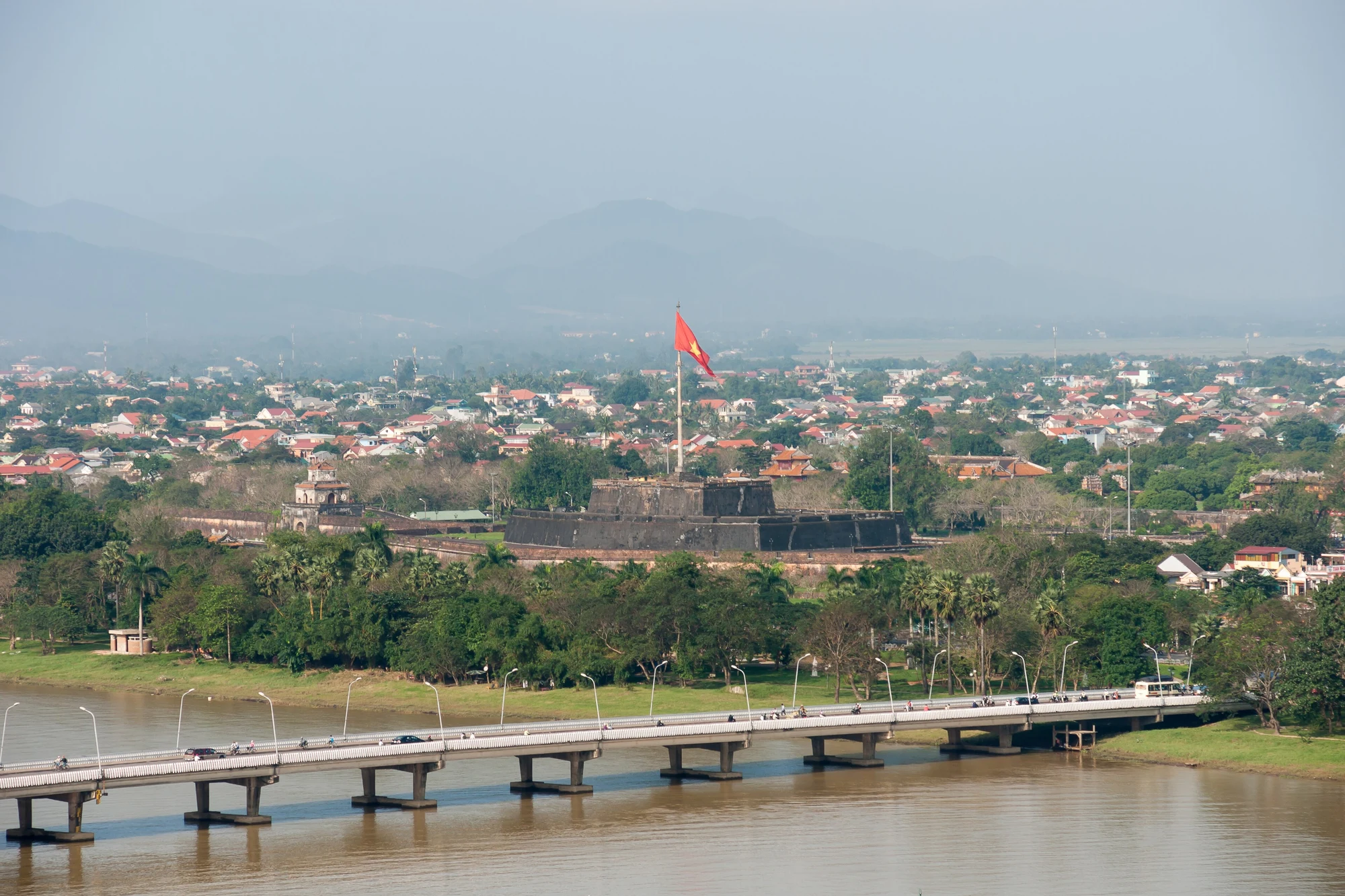
The same researchers set out the geomantic scheme: Ngự Bình as the front screen, the Perfume River as the bright hall, Cồn Hến and Cồn Dã Viên as Green Dragon and White Tiger. You can check this from the river bank near the southern gates. Stand facing south and find the flat-topped hill, then look for the two islets to the left and right.
This also explains an oddity. The citadel faces southeast, not true south, because the wall has been turned to meet a river and a hill. Engineers care about lines of fire; geomancers care about what you face. Huế’s plan shows both demands at once.
Count the gates and read the additions
Reports count ten main gates, four on the south and two each on the north, west and east, plus one to Trấn Bình Đài and two water gates on the Ngự Hà. That is why totals of 10, 11 and 13 all circulate.
The gates are also a timeline. Most were built from 1809, and their watchtowers were added in 1824, 1829 or 1831, so a gate is not one date. Look for how water enters as well, since moats and rivers served both defence and transport, and the Ngự Hà is the only waterway crossing the citadel. In 1968, fighting reached these walls and guns on the outer towers became targets, which is one reason to look closely at surfaces you might assume are old.
A short walk that makes the idea stick
You do not need the full 10 kilometres. Choose one stretch between two gates and walk it slowly, ideally in the cool of early morning or late afternoon. Press reports describe a pedestrian route on the Thượng Thành rampart from Cửa Ngăn past the Flag Tower to Quảng Đức Gate, used for an open-air exhibition. Check on the day that it is accessible, and do not climb on sections that are closed or unstable.
Bring a simple question: at this point, is the wall acting for gunners or for a geomancer? A bastion answers one way, a river-facing gate the other. People live inside these walls, so keep to public paths and treat lanes and yards as neighbourhoods.
Questions travellers ask
Was Hue’s citadel designed by French engineers?
It is described as Vauban-style, but the sources used here do not name a French designer. Treat specific attributions as a question to put to the conservation centre or a specialist guide.
How many gates does the citadel have?
Ten main gates is the usual count, with one more to Trấn Bình Đài and two water gates. Other totals appear because writers count different things.