Cho Lon’s shophouses: a slow architecture walk beyond Thien Hau Temple
Walk Cho Lon without a tour: how to read French-Chinese shophouses on Hai Thuong Lan Ong, then assembly halls beyond Thien Hau, with the old trades still in use.
 Cat Ba Connect4 min read
The short answer
To read Cho Lon’s architecture, walk Hai Thuong Lan Ong first and look above the shop signs. Many of these houses have a ground floor and two upper floors, a French-Chinese mix modelled on Guangzhou, with carved gable ends. Then choose two halls beyond Thien Hau, such as Nghia An or Ha Chuong on Nguyen Trai and Nhi Phu on Hai Thuong Lan Ong. This is a working district, so walk slowly, keep clear of deliveries and buy something if you stop to look closely.
Look above the shutter line
Thiên Hậu Temple draws most visitors, and our Cho Lon guide covers it well. The rest of the district asks you to raise your eyes. A Tuổi Trẻ architecture series says that the Hải Thượng Lãn Ông area formed after 1864 under French control, and that old houses there often have a ground floor and two upper floors, in a French and Chinese mix modelled mainly on houses in Guangzhou.
Its detail is what to look for: the mặt dựng, a decorated gable end at the eaves, showing a dragon-horse carrying a river chart, a sign of good fortune. Stand on the far pavement, since you cannot see these from directly beneath, and look past the air-conditioners and awnings. Which floor still has shutters? Where has a new facade been stuck over an old one?
A street is a trade before it is an address
Chinese settlement gave Cho Lon its plan, and trade gave it its streets. VnExpress described Hải Thượng Lãn Ông in 2011 as the medicine street and Triệu Quang Phục as a scissors street, with more than 35 years of making and repair. A 2017 report describes the city’s plan for Lương Nhữ Học as a model traditional-medicine street, alongside Hải Thượng Lãn Ông and Triệu Quang Phục.
So do not just photograph the fronts. Smell the street, and note where shop gives way to storage and family life. Triệu Quang Phục was once Rue de Canton, a commercial heart of the early 20th century. Ask a shopkeeper how long the family has been there, but wait until they are not serving.
Assembly halls beyond the famous one
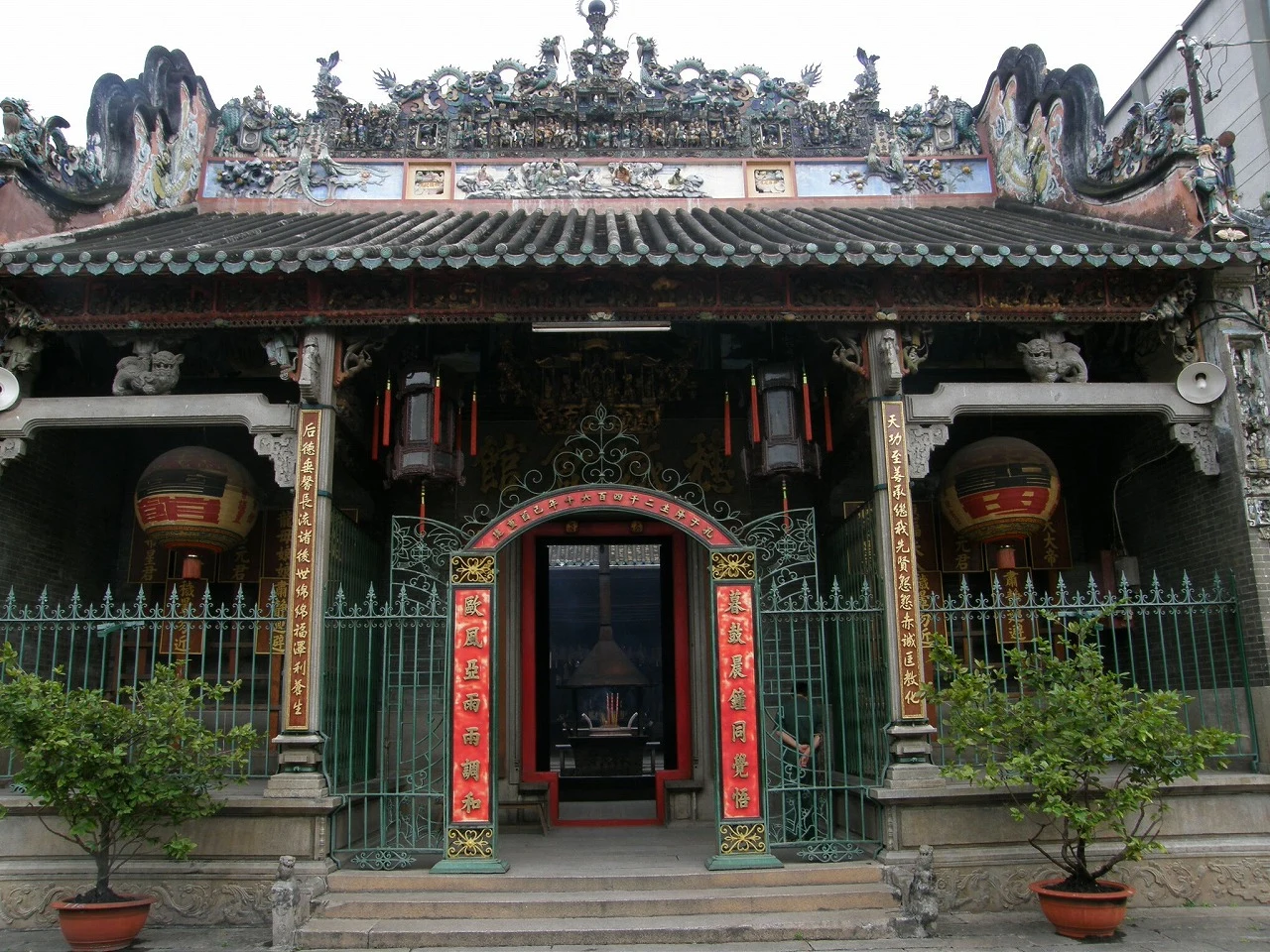
VinWonders says that central Cho Lon once had more than 30 assembly halls, some nearly 300 years old. Vietcetera’s walk gives you a practical shortlist: Nghĩa An at 678 Nguyễn Trãi, Hà Chương at 802 Nguyễn Trãi, Nhị Phủ at 264 Hải Thượng Lãn Ông, Quỳnh Phủ at 276 Trần Hưng Đạo and Ôn Lăng on Lão Tử, which honours 16 deities. Nhị Phủ is credited to the Fujian community in the 18th century, dedicated to Ông Bổn and listed as a national relic in 1998.
Choose two. Ask who built the hall and whose worries sit on the altar, because that separates one community from another inside the single word Chinatown. Check that each is open. Our Thiên Hậu guide has advice on worship and photography that applies to all of them.
Old names help you see old structure
VnExpress’s then-and-now article is an excellent walking aid. Trần Hưng Đạo was Đồng Khánh. Phùng Hưng was Rue de Paris, with a Chinese theatre that later became a treasury. Tản Đà was Jaccaréo. The Hàng Bàng canal, filled in around 2000 and later restored, is a reminder that this was a water city, with rice arriving by boat from the Mekong.
Bình Tây Market, built in 1928 by the merchant Quách Đàm, has an octagonal plan with 12 gates, and the Cha Tam church dates from 1900 to 1902. They mark what a Cho Lon fortune could build. If you can, walk one route with an old photograph on your phone.
A route you can walk alone
No tour is required. Start at Hải Thượng Lãn Ông, take in the shophouses and Nhị Phủ, cross to Triệu Quang Phục, then go along Nguyễn Trãi towards Thiên Hậu and Hà Chương. Two hours is a reasonable length, and morning is when shops are active. Check a current map, because district names have changed: since 2025 many pages say Chợ Lớn Ward rather than District 5.
Pavements here are narrow and occupied, so walk with deliveries in mind and do not stop in doorways. Ask before photographing people, particularly older shopkeepers and anyone at worship. Interiors are private unless a shop invites you in, so end with a meal: a local restaurant may be the only old interior you get to sit in.
Questions travellers ask
Do I need a guide to walk Cho Lon?
No. The main streets and halls can be walked on your own with a current map. A guide helps if you want family histories or Chinese-language inscriptions explained.
Are the assembly halls open to visitors?
Many receive visitors, but they are community and religious spaces. Check opening on the day, dress modestly, and treat offerings and worshippers as you would in any temple.